

Watching and Waiting
And Taking Up Space

A recent workshop on Scene from Marya Hornbacher of Caravan Writers Collective prompted this essay about a recent visit to a surgery center waiting room, which turned out to be a study in who is, and who is not, allowed to take up space.
The elevator from the parking garage delivers us directly into the surgery center waiting area. We check in, my patient fills out the forms, I confirm I’ll be driving her home, she gets her wristband. It’s early afternoon and there are around a dozen people waiting, either for their procedure or for their patient, spread out over an assortment of normal chairs, tall chairs, and double-wide chairs not quite wide enough to be a love seat, backs to the wall along three sides of the room. We choose two human-size chairs in the corner.
An older couple and a younger couple, each white, each pair holding hands, are seated against the back wall. A Black family, a younger woman and an older couple, is sitting at a counter, talking quietly among themselves. An older white guy in jeans, a checked shirt, a baseball cap and a barn coat—let’s call him the cowboy—is sitting on his own, fidgeting and sighing.
Two women are chatting in Spanish. One, wearing a beanie over a bald head, is the first to be called in for what we learn later is a mastectomy. Her companion, older, gray hair, with matriarch energy, immediately calls someone and proceeds to talk loudly in Spanish on the phone - talk as in talk not listen - barely pausing for breath.
Fifteen minutes or so into her monologue, the female half of the older couple at the back, looking somewhat annoyed, but mostly just very nervous, catches my eye and says softly “people who want to talk on the phone should go somewhere else.”
It’s two days after Bad Bunny’s Superbowl half-time show. Taking up space while speaking Spanish is still not OK.
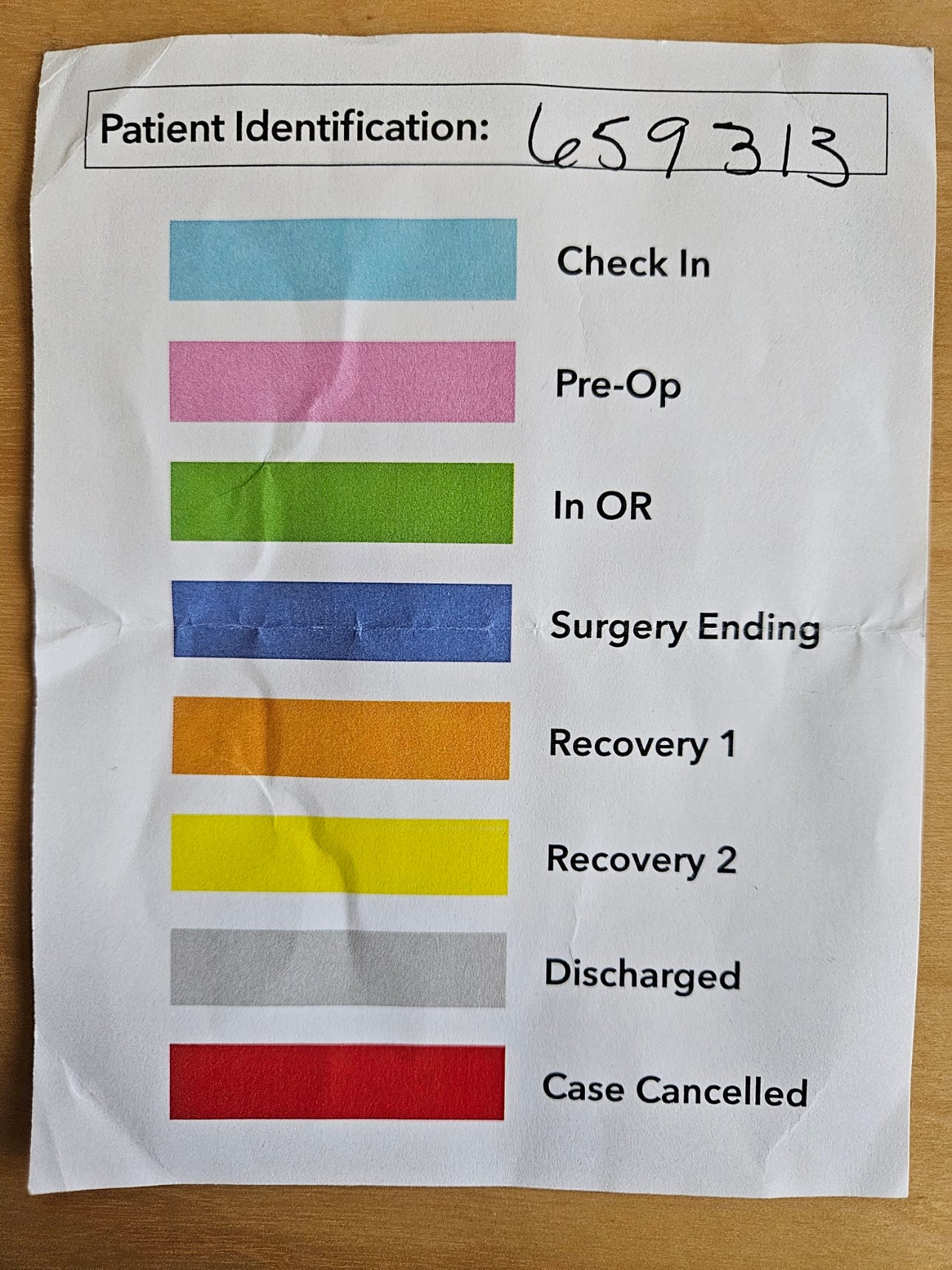
My patient is called in, and I start to track #659313, one of a dozen numbers on the screen, as the background changes to pink for Pre-Op.
The matriarch finishes her call, but the silence is soon broken by the cowboy playing videos out loud on his phone, just loud enough to be annoying.
No one says a word.
#659313 changes to green for In OR. The check-in clerk told us that they’d booked the OR for 138 minutes, so I head out for a walk in Seattle’s Fool’s Spring, a warm and sunny prelude to Second Winter.
Shirtless joggers wearing earbuds, staring straight ahead, and avoiding eye contact, take up space on the narrow, cracked sidewalks of this older residential neighborhood, leaving me and moms with strollers with no option but to yield.
When I return, I reclaim my seat near the younger couple. After her man is called in, the woman arranges herself in lotus position on a double-wide chair and pulls out her crochet. Our cowboy asks her what she’s knitting. “Actually, it’s crochet, but I don’t correct people,” she says, correcting him, “they look the same.”
“Mostly I knit things as gifts,” she continues, “My sister’s a doctor at Children’s. I love making things to give to the kids.”
“Your husband, what’s he in for?”
“A vasectomy. We’re both nearly forty, so...”
“Frozen peas! After mine, I just slapped a bag of frozen peas on my crotch for a couple of hours and then I played golf!”
The cowboy’s wife, we hear, is in for her sixth back surgery, a wound that just won’t heal. He sounds sad and scared and is just needing to talk. The crochet woman senses that, listening politely and laughing along.
We learn that the cowboy is from Spokane, doesn’t like Seattle, something, something, “protesters”—the hospital is on Capitol Hill—something, something, “this 9 mm in my pocket.” He lives on five acres near Chehalis now with two neighbors, one of whom he doesn’t like. Oh, and he’s built a meat processing plant behind his house.
The woman puts her crochet away, gets up, and tells him she’s going out for a smoke.
A couple has relieved the matriarch, and a young woman with darker complexion, possibly of South Asian ancestry, sits down near me, wearing leggings and a camel coat. She pulls the hood up over her head and starts to read a book.
The cowboy talks to her anyway.
He tells about how many houses he’s built, how he’s done doing that, how expensive houses are in Seattle. She says they’re even more in Canada. He asks her where she’s from. Here, she says, but her partner is from Canada.
Just then, a nurse calls her over to see her mother in recovery two. As she’s walking away, the cowboy calls out after her “that other lady’s husband is having a vasectomy!”
“Oh, wow, I don’t think I’ve ever met anyone who’s had a vasectomy,” she says, cutting him off.
If you’re a young solo woman, your boundaries will be ignored, no matter how clearly you draw them, and your personal space will be invaded, no matter how little space you take up or how well you defend it. If you’re an older white guy, you can... Well, we’re living with that every day.
The room is thinning out. We’re down to the last half dozen patients on the screen, most now in some stage of recovery.
The doctor calls to let me know the procedure went well, that my patient is in recovery one, and that I should be able to see her in about an hour. I confirm that #659313 is indeed now orange. A half hour later, a nurse calls to tell me that they’re working to get her postoperative pain under control.
Cowboy is over with his wife’s doctor, who’s already traded his scrubs for a white coat and stethoscope, and is talking earnestly. I hear snippets; “We weren’t able to…” and “We might have to…” It seems she’s staying the night. The guy has been there all day.
An hour later, #659313 is still orange for recovery one, not yellow for recovery two, and I’m getting a little antsy, so I start slowly pacing the room to stretch my legs.
The Black family is in a hushed but tense conversation with a nurse, their patient sleeping on the rolling bed beside them on her way to recovery two. I move away to give them some space, but catch some of the conversation, and certainly the tone of it, which is calm, but firm.
“We’ve been here since early this morning, and no one’s told us anything. Can we talk to the doctor?”
“The doctor’s already left the building. Didn’t he call you?”
“No.”
I hear the older Black woman say “I’m a retired nurse, and…”
After the huddle breaks up, I resume my pacing. Over by the elevators, I find the retired nurse, her lips tight shut, a tear on her cheek.
“I’m so sorry,” I offer. “It’s going to take another generation or two before it changes.”
“But it will change,” she says, “it will change.”
“It has to,” I agree, “we can’t go on like this.”
Another hour and here’s a nurse, pushing #659313’s bed down to recovery two. “You can follow us,” she says, avoiding eye contact. She’s a younger Black woman and she’s not having a good day. I’m not judging. Much as our health care environment sucks for patients, it’s worse for staff. She hooks the patient up to the machines in the recovery room. I’m curious about the status.
“Um, so, where are we?” I ask, nervously.
“With what?” she challenges, looking me dead in the eye. And then, breaking eye contact again, “we’re trying to manage her pain.”
I shift into deescalation mode and begin thanking her effusively for every small thing she does. She leaves the room. When she returns some minutes later, the mood is already lighter. After another hour there’s progress with the pain, and as the nurse senses that she’ll have the patient discharged before the end of her shift, her mood improves even more.
Her name badge says she’s Sonia, and I hear a hint of a Caribbean accent. “Sonia, are you from the islands somewhere?”
“Yeah, I’m from Jamaica, but I’ve been here a while,” she says, smiling now.
“Well, you still have a bit of the accent, although I’m no one to talk, I’m from England.”
“Yes, I thought I heard that. Oh, I want to go England, London, Edinburgh, all the places.” She’s laughing now. “Let me get your discharge paperwork.”
I follow a number of doctor/writers on the Substack platform who universally comment on the challenges of working in our broken health care system. I offered to one in a comment thread that I always fill out the questionnaire before my appointments; I stick to no more than one or two topics; I show up on time; and I’m polite not just to the provider but to the scheduler, the techs, and the nurses. The author replied that it’s a shame that we’ve come to this, where I have to manage my providers’ mental health. A lifetime of neurodivergence-driven hypervigilance has prepared me. All that, and having every privilege—being a fit and healthy, pleasant-presenting, educated, literate, older white guy with a cute accent—gets me good care, the standard of care we all deserve.
I think about people who check fewer of those boxes—they’re Black or Brown, English is their second language, they have chronic morbidities, they’re just having a bad day—and wonder about the standard of care they receive. It’s heartbreaking to witness that not checking just one of those boxes—skin color—means a lower standard of care.
But I’ve just witnessed a room full of strangers sort and rank themselves into a hierarchy by skin color, ethnicity, gender, and age, a hierarchy that has real consequences, not just in healthcare outcomes, but in access to education, jobs, housing, and general wellbeing.
This is not an accident or a moral failing.
The hierarchy has been around for millennia. It is designed and maintained to keep us busy guarding our place in it so that we don't notice that those on the very top are making off with the lion's share of the resources; resources that should be keeping us all in abundance, not engineered scarcity.
It has to change. Prove me wrong about it needing a generation or two.
Thanks, as always, for reading. To make sure you don’t miss a post, please become a free or paid subscriber.
Wonderful essay John! Riveting and necessary things you brought to focus here and done it with such grace. Thank you for this read 💜
I have often wondered about taking space. It is not something that is permitted by design to everybody, as you have effectively shown in this narrative. I think wilfully taking up space too, is an act of rebellion against systems that keeps the hierarchy intact.
This was beautiful and infuriating. Thank you for writing this, John.